A Complete Birdwatching Guide to Spotting the Clay-Colored Thrush in Costa Rica
Costa Rica's National Bird You'll Hear Before You See
The song begins before dawn, a series of rich, flute-like phrases that seem to echo from everywhere and nowhere at once. If you’re staying anywhere in Costa Rica during the early rainy season, this is your alarm clock – the clay-colored thrush announcing another day in the tropics.
Most visitors arrive expecting scarlet macaws and resplendent quetzals, birds that stop you in your tracks with pure visual drama. The clay-colored thrush takes a different approach. Its brown plumage blends into forest shadows and garden shrubs. You might walk past a dozen without noticing. But once you learn to recognize that song, you’ll realize this bird has been your constant companion since you arrived.
Andrea, our birding enthusiast at Copa De Arbol, has spent years studying Costa Rican avifauna. She remembers her first encounter with the Yigüirro (as locals call it): “I was in Monteverde, frustrated because I kept hearing this gorgeous, complex song but couldn’t locate the source. When I finally spotted the bird, I thought I’d made a mistake. That plain brown bird couldn’t possibly be producing that sound. But it was. That’s when I understood why Costa Ricans chose this species as their national symbol.“
Jump To:
- Why Costa Rica Chose an “Ordinary” Bird
- Identifying the Clay-Colored Thrush
- Behavior and Ecology
- Where and When to Find Clay-Colored Thrushes
- Clay-Colored Thrush vs. Costa Rica’s Iconic Species
- Observing Clay-Colored Thrushes: Practical Tips
- Why This Bird Matters Beyond Birding
- Conservation Status and Ecological Role
- Planning Your Stay at Copa De Arbol
- Beyond the Yigüirro
- Final Thoughts
- FAQs
Why Costa Rica Chose an "Ordinary" Bird

In 1977, Costa Rica needed a national bird. The obvious candidates were there – brilliant tanagers, massive toucans, emerald quetzals. Instead, the government chose Turdus grayi, a medium-sized brown thrush that looks remarkably similar to dozens of other thrush species worldwide.
The decision wasn’t about appearance. It was about presence, voice, and cultural meaning.
The clay-colored thrush inhabits every corner of Costa Rica, from sea-level mangroves to mid-elevation coffee plantations. It thrives in primary rainforest and urban parks with equal success. While tourists chase rare cloud forest specialists, Costa Ricans wake up to the Yigüirro’s song in their backyards. This accessibility matters – the national bird should be everyone’s bird, not just those who can afford guided tours into remote reserves.
The timing of its breeding season creates a perceived (though not actual) connection to the rainy season. The bird begins singing intensely in late April and May, right as the first substantial rains arrive. For generations of Costa Rican farmers, this coincidence marked the beginning of the planting season. The Yigüirro became woven into agricultural rhythms, folklore, and daily life in ways more spectacular species never could.
There’s also the song itself. Andrea explains: “Costa Ricans value ‘pura vida‘ – the simple, pure life. The Yigüirro embodies that. It’s not flashy, but it has this beautiful, complex song that requires you to stop and listen. It rewards attention rather than demanding it.“
The species name grayi honors British zoologist John Edward Gray, but locals rarely use the scientific name. “Yigüirro” – a name derived from indigenous languages and spoken with obvious affection.

Did you know Costa Rica has both Pacific and Caribbean coastlines—meaning you can watch the sunrise on one beach and the sunset on another in the same trip?
Identifying the Clay-Colored Thrush
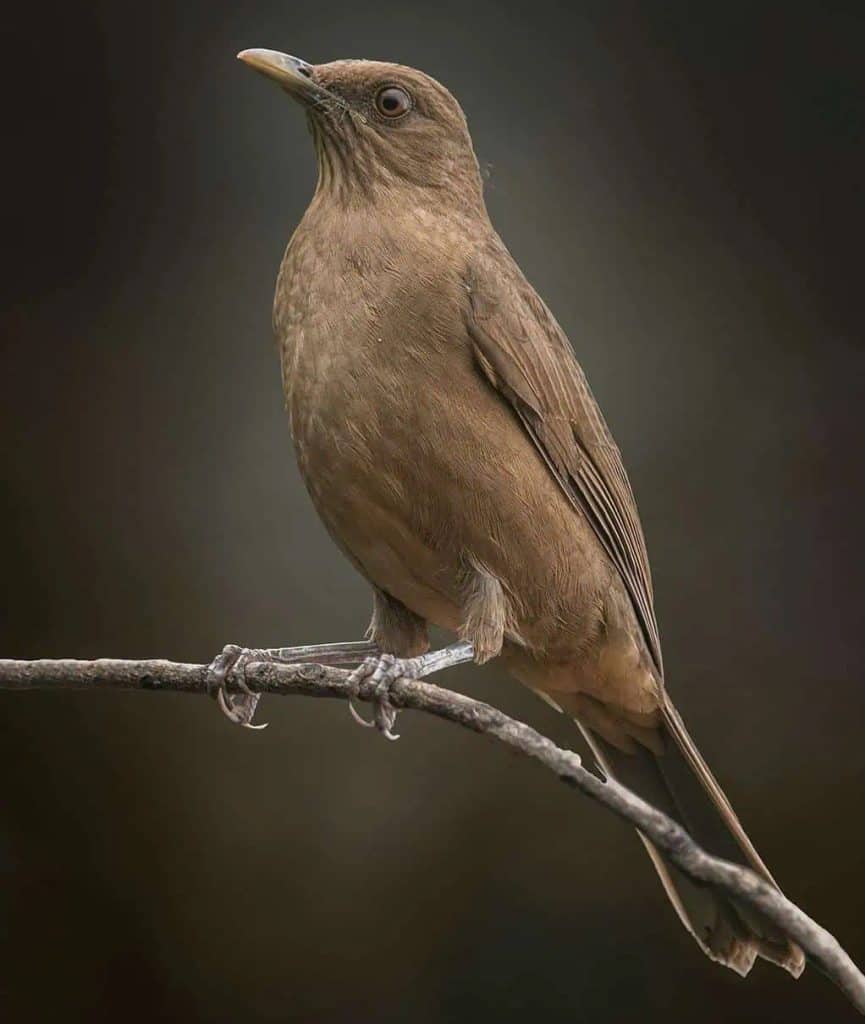
If you’re accustomed to North American or European birds, the clay-colored thrush will immediately remind you of several species you know. That’s because it belongs to the same genus (Turdus) as the American robin, European blackbird, and dozens of other familiar thrushes. The body plan is nearly universal across the genus: medium-sized, somewhat plump, upright posture, and ground-foraging behavior.
Physical Characteristics
The plumage is various shades of brown – imagine wet clay, and you’ve got the color. Upperparts (back, wings, tail) run slightly darker, while underparts show paler tones with subtle buff or grayish tints. There’s no dramatic contrast, no iridescence, no bold patterns. In certain light, you might notice slight olive tones in the plumage, but generally, this is a study in earth colors.
Size-wise, think American robin. The clay-colored thrush measures 23-27 cm (9-10.5 inches) in length with a wingspan around 38-40 cm (15-16 inches). Weight averages 74-76 grams – substantial enough to be easily observed but small enough to be agile in dense vegetation.
The bill deserves attention. It’s straight, moderately stout, and ranges from yellowish-orange to bright orange depending on individual and season. Against the brown plumage, this pop of color becomes the bird’s most noticeable field mark. The legs are pinkish-brown to grayish.
Monomorphism
Unlike many bird species where males and females show different plumage (sexual dimorphism), both sexes of the clay-colored thrush look identical. This monomorphism extends beyond plumage to size and structure – you cannot visually sex these birds in the field. This characteristic is relatively unusual among thrushes and makes field identification straightforward once you know the species.
Juveniles do show subtle differences – slightly spottier plumage with faint streaking on the breast – but by their first year, they’re indistinguishable from adults.
Vocalization
This is where identification becomes unmistakable. The song consists of rich, melodious phrases – a series of clear whistles and warbles delivered in unhurried succession. Each phrase typically contains 3-5 notes, with noticeable pauses between phrases. The overall effect is conversational, almost contemplative, rather than the rapid-fire delivery of many tropical species.
Andrea’s technique: “Record it on your phone during your first morning. Play it back occasionally as you explore. Your ear will start picking it out of the forest chorus, and suddenly you’ll realize how abundant this species actually is.“
The bird also produces various calls – sharp “tchuck” notes when alarmed, softer contact calls between mates. But the territorial song, heard primarily during breeding season (April-August), is what you’ll encounter most frequently.
Did you know Costa Rica has both Pacific and Caribbean coastlines—meaning you can watch the sunrise on one beach and the sunset on another in the same trip?
Behavior and Ecology

Understanding how the clay-colored thrush lives makes finding and observing it significantly easier.
Habitat and Range
The species occupies an impressive elevational range, from sea level to approximately 2,500 meters. This tolerance for varied conditions explains its countrywide distribution. You’ll find clay-colored thrushes in:
- Primary and secondary rainforest, particularly edges and gaps
- Cloud forest understory
- Coffee and cacao plantations
- Urban parks and gardens
- Agricultural areas with scattered trees
- Mangrove edges
- Suburban neighborhoods
The key requirement seems to be a combination of cover (trees or shrubs for nesting and roosting) and open ground (for foraging). Purely open areas like pastures lack sufficient cover. Extremely dense, closed-canopy forest has limited ground access. The sweet spot is anywhere these two elements coexist.
At Copa De Arbol, clay-colored thrushes frequent the transition zones between our gardens and the primary forest. They’re particularly common near the dining area, where ornamental plantings provide food sources and manicured lawns offer easy foraging.
Foraging Behavior
Watch a clay-colored thrush hunt and you’ll see classic thrush behavior. The bird hops along the ground, pausing frequently. During pauses, it tilts its head, apparently listening for movement beneath leaf litter. When it detects something, it rapidly pecks or probes, extracting invertebrates from the soil or litter.
Diet consists primarily of insects, earthworms, and other invertebrates, supplemented heavily with fruit. The species is particularly fond of berries and will feed extensively on fruiting trees and shrubs. This fruit consumption makes them important seed dispersers in Costa Rican ecosystems.
During fruiting peaks, you might observe multiple clay-colored thrushes feeding in a single tree, temporarily setting aside their typical territorial aggression in favor of shared abundance. These aggregations offer excellent observation opportunities.
Breeding and Territoriality
The breeding season runs roughly April through August, coinciding with the early rainy season. Males become intensely vocal during this period, singing from exposed perches to advertise territories and attract mates.
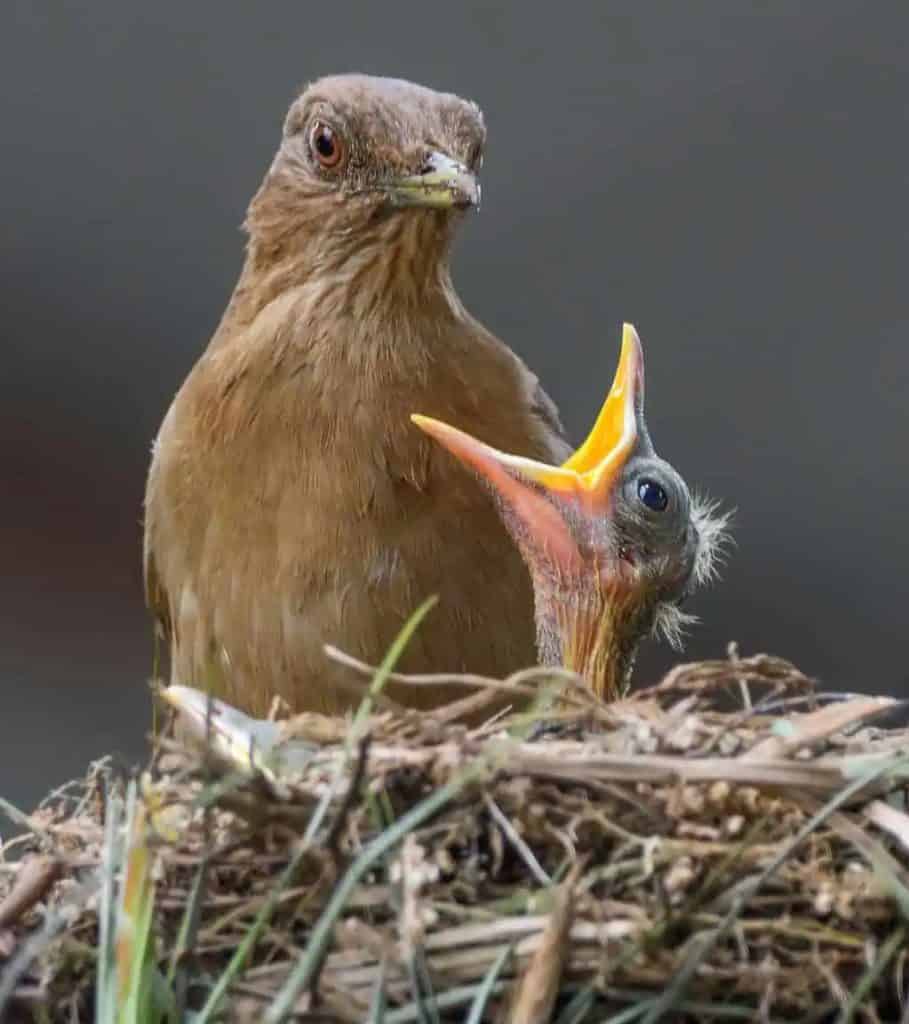
Nests are constructed by both sexes, typically placed 2-5 meters above ground in dense shrubs or tree forks. The cup-shaped nest uses grasses, rootlets, and mud, lined with finer materials. Females lay 2-3 eggs, pale blue with reddish-brown spots.
Both parents feed nestlings, making frequent foraging trips and approaching the nest from different angles to avoid revealing its location. This is one of the best times to observe the birds closely – they’re focused on provisioning and less wary of stationary observers.
If you find an active nest, resist the urge to approach closely or repeatedly. Observe from a distance with binoculars.
Where and When to Find Clay-Colored Thrushes

Geographic Locations
Since the species occurs throughout Costa Rica, the better question isn’t “where can I find them” but “where can I observe them well.” These locations offer particularly good viewing conditions:
- Monteverde Cloud Forest Reserve – The network of trails passes through ideal thrush habitat. Early morning walks along the entrance trails typically produce multiple sightings and excellent song playback opportunities.
- La Selva Biological Station – Caribbean lowlands support high thrush densities. The station’s maintained grounds and trail system make observation straightforward. Researchers here have banded and studied clay-colored thrushes for decades, so guides can often show you specific known individuals.
- Arenal Observatory Lodge – The lodge grounds, with their combination of lawns, forest edge, and ornamental plantings, attract numerous thrushes. Dining on the terrace while watching them forage below is a quintessential Costa Rica experience.
- Carara National Park – The transition zone between Pacific dry forest and wet forest creates edge habitat that thrushes exploit heavily. The loop trail near the entrance provides accessible birding.
- Manuel Antonio National Park – Despite heavy tourist traffic, clay-colored thrushes remain common in less-disturbed sections. The trail to Cathedral Point typically offers good sightings.
- Osa Peninsula (Copa De Arbol) – Our location provides an advantage: you’re birding from your cabin. Clay-colored thrushes are present daily in the gardens and along trails. You don’t need to travel to find them – they’re part of your immediate environment. Our guides can show you active territories, nesting sites, and prime foraging areas within a five-minute walk of the lodge.
Seasonal Timing
While clay-colored thrushes are non-migratory residents observable year-round, seasonal patterns affect behavior and detectability:
- Dry Season (December-April) – Birds are less vocal outside of early season (December-January may still catch some song). However, visibility improves as vegetation thins and birds concentrate around remaining fruit sources. Foraging behavior is easily observed. This is ideal for photography – good light, predictable behavior, and clear sightlines.
- Early Rainy Season (May-August) – Peak vocalization. Males sing intensively, making detection trivial. Nesting activity provides behavioral observation opportunities. The forest is lush and green, creating beautiful backdrops. Morning rain is uncommon, leaving most birding time dry. This is the season to experience what made the Yigüirro culturally significant.
- Peak Rainy Season (September-November) – Vocalization decreases as breeding concludes. Afternoon rains are heavy and predictable, but mornings remain productive. Birds are often observed bathing and foraging after rain showers. Tourist numbers drop, creating quieter observation conditions.
- Transition Period (Late November-Early December) – Balanced conditions. Some individuals begin re-establishing territories and may sing sporadically. Comfortable temperatures and mixed weather. Fewer visitors than peak season.
Andrea’s recommendation: “Visit during May or June if the song is important to you. Visit December-February if photography is your priority. Visit any time if you just want to observe the species – they’re always here.“
Clay-Colored Thrush vs. Costa Rica's Iconic Species
Clay-Colored Thrush vs. Other Iconic Birds
Bird Species | Key Trait | Habitat | Birding Difficulty |
Clay-Colored Thrush | Melodic song, earthy tones | Countrywide | Easy |
Scarlet Macaw | Bright red, loud calls | Osa Peninsula, Carara | Moderate |
Resplendent Quetzal | Emerald green & crimson | Highlands | Difficult |
Violet Sabrewing | Large hummingbird, purple | Cloud Forests | Moderate |
Observing Clay-Colored Thrushes: Practical Tips

Visual Location Technique
Listen first. Learn the song and let your ears do the work.
When you hear singing, scan exposed perches – tree tops, fence posts, building peaks.
For foraging birds, check ground level in semi-open areas with nearby cover.
Move slowly and pause frequently. The birds will resume activity once they determine you’re not a threat.
Photography Considerations
- The brown plumage creates technical challenges. In heavy shade, the bird can appear as a dark silhouette. In bright sun, details get lost. The best light is indirect – overcast skies or open shade.
- Recommended settings: Shutter speed 1/500 or faster (the bird moves quickly when foraging). Aperture around f/5.6-f/8 for adequate depth of field. ISO adjusted to maintain proper exposure – often 800-1600 in forest conditions.
- The orange bill provides a natural focus point.
- Expose for the bill and let the plumage fall where it may – this typically produces the most pleasing results.
- Ground-foraging behavior offers opportunities for eye-level shots if you’re willing to sit quietly. Position yourself near known foraging areas and wait. The birds will approach if you remain still.
Behavioral Observation
For serious study, pick an individual or pair and watch for 30-60 minutes. You’ll start noticing patterns: preferred foraging routes, territorial boundaries, interaction patterns with other species, response to potential threats.
Nesting birds provide fascinating observation, but maintain respectful distance. Use binoculars or a spotting scope rather than approaching closely.
● Binoculars (8x42 or 10x42) ● Field guide ● Recording device (phone works fine) to capture the song ● Camera with telephoto lens if photography interests you ● Neutral-colored clothing ● Patience - clay-colored thrushes are common, but quality observations require time
Why This Bird Matters Beyond Birding

The clay-colored thrush appears in Costa Rican poetry, music, and art with surprising frequency. Its song has been recorded by numerous Costa Rican musicians and incorporated into compositions. Children learn about the Yigüirro in school as a symbol of national identity.
This cultural embedding means observing the species offers genuine insight into Costa Rican values. The choice of an accessible, widespread, vocally gifted but visually plain bird as a national symbol reflects priorities: democratization over exclusivity, substance over flash, everyday beauty over rare spectacle.
When Costa Ricans talk about “pura vida,” they’re often referencing this mindset – finding richness in simple, authentic experiences. The clay-colored thrush embodies that philosophy.
Conservation Status and Ecological Role

The clay-colored thrush is listed as Least Concern by the IUCN. Its population is stable, and habitat adaptability means it’s thrived even as Costa Rica has developed. Unlike specialist species that require pristine habitat, the Yigüirro exploits human-modified landscapes successfully.
This adaptability shouldn’t breed complacency. The species serves important ecological functions, particularly seed dispersal. Many Costa Rican plants rely on thrushes to distribute their seeds. Remove the thrushes and you cascade through the ecosystem.
Climate change poses potential risks. While the species’ broad elevational range provides some buffer, shifting rainfall patterns could disrupt breeding timing and success. Research is ongoing, but preliminary data suggests clay-colored thrushes may be advancing their breeding season as rainy season patterns change.
Planning Your Stay at Copa De Arbol

We’ve designed our property to support natural bird behavior while providing excellent observation opportunities. Native plantings produce berries and attract insects. Our dining terrace overlooks prime foraging territory.
Clay-colored thrushes are present daily. You don’t need to book a specific tour to observe them – they’re simply part of your environment during your stay. However, our guided birding walks provide context and expertise that independent observation can’t match. One of our naturalist guides can show you territorial boundaries, explain behavior you’re witnessing, and position you for photography.
For families: Kids often find the clay-colored thrush more engaging than rarer species because they can observe actual behavior – foraging, singing, territorial disputes – rather than just checking a species off a list.
For couples: Early morning coffee on your balcony, accompanied by Yigüirro song, is a quintessentially Costa Rican experience. Combine it with a private nature walk to see the birds up close.
For serious birders: Use the clay-colored thrush as your “confidence species” while settling into Costa Rican birding. Learn its song thoroughly, then use that knowledge to develop your ear for tropical bird vocalizations.
Book your stay at Copa De Arbol and experience Costa Rica’s national bird in its natural habitat alongside dozens of other species.
Beyond the Yigüirro

While the clay-colored thrush anchors this guide, our location supports 320+ recorded bird species. A typical morning walk produces sightings of toucans, trogons, tanagers, woodcreepers, antbirds, and numerous others. The Yigüirro is your reliable companion, but the Osa Peninsula’s biodiversity means every birding session yields surprises.
We also maintain resources on other Costa Rican species:
Final Thoughts

The clay-colored thrush won’t dominate your Costa Rica photos the way a resplendent quetzal or scarlet macaw might. It won’t be the bird you tell friends about first when you return home. But if you spend time observing it – really watching its behavior, learning its song, understanding its role in Costa Rican culture – it may be the bird you remember most clearly years later.
Andrea puts it this way: “Once you’ve learned to appreciate the Yigüirro, every other bird becomes more interesting because you’re looking deeper than surface appearance.“
That’s ultimately why Costa Rica chose this species. Not because it’s the most beautiful or rare, but because it represents the deeper truth of biodiversity – that every species, observed with care and respect, reveals complexity and beauty. The plain brown bird with the gorgeous song is precisely the right symbol for a country that’s staked its identity on environmental protection and authentic nature tourism.
Start Planning Your Birdwatching Vacation
If you’re planning a family trip, romantic getaway, or wildlife adventure, Copa De Arbol is the perfect base. Explore our eco-luxury accommodations, dine in open-air rainforest settings, and book a birdwatching tour that introduces you to Costa Rica’s incredible avian life
Come see the Yigüirro for yourself. We’ll be listening for its song at dawn.
Frequently Asked Questions
The clay-colored thrush produces a rich, melodious song consisting of clear whistled phrases with 3-5 notes each, delivered with noticeable pauses between phrases. The overall effect is conversational and unhurried – think flute-like warbles rather than rapid trills. The song is most prominent during breeding season (April-August) and is typically heard from exposed perches at dawn and dusk. Males also produce sharp “tchuck” alarm calls and softer contact notes. Recording the song on your phone during your first morning in Costa Rica helps train your ear to pick it out from the forest chorus.
Costa Rica designated the clay-colored thrush (Yigüirro) as its national bird in 1977 for cultural and symbolic reasons rather than visual spectacle. The species is found throughout the entire country from sea level to 2,500 meters, making it accessible to all Costa Ricans rather than just those who can travel to remote areas. Its melodious song coincides with the beginning of the rainy season in late April and May, traditionally signaling planting time for farmers. The bird embodies Costa Rican values of “pura vida” – finding beauty in simple, authentic things rather than only celebrating the rare or flashy. Its adaptability, resilience, and constant presence in both wild and urban areas made it the perfect symbol for a country built on environmental stewardship and everyday appreciation of nature.
Clay-colored thrushes are found throughout Costa Rica, making them one of the easiest birds to observe. Top locations include Monteverde Cloud Forest Reserve (excellent trail access), La Selva Biological Station (Caribbean lowlands with high densities), Arenal Observatory Lodge (birds forage on lawns near dining areas), Carara National Park (transition zone habitat), Manuel Antonio National Park (despite tourist traffic), and the Osa Peninsula where Copa De Arbol is located. The advantage of staying at an eco-lodge like Copa De Arbol is that thrushes are present daily in gardens and along trails – you observe them as part of your immediate environment rather than traveling to specific viewing locations.
Clay-colored thrushes show peak activity during two daily periods: dawn (5:30-8:30 AM) and late afternoon (4:00-6:30 PM). Dawn activity is particularly intense as birds emerge from overnight torpor and begin territorial singing and foraging. Breeding season (April-August) produces the most vocal behavior, with males singing intensively from exposed perches. Outside breeding season, the birds remain active but are less vocal, making them slightly harder to locate by sound. Mid-day activity decreases during hot hours, though foraging continues in shaded areas. Early morning birding walks provide the best observation opportunities year-round.
The clay-colored thrush is omnivorous with diet varying seasonally. Primary foods include invertebrates (insects, earthworms, larvae) gleaned from ground foraging, plus substantial fruit consumption from berries and small fruits. The birds use a characteristic foraging behavior – hopping along the ground while pausing frequently to tilt their heads, apparently listening for movement beneath leaf litter before rapidly pecking or probing. During fruiting peaks, multiple thrushes may feed together in a single tree. This fruit consumption makes them important seed dispersers in Costa Rican ecosystems, as seeds pass through their digestive systems and are deposited across their territories.
You cannot visually distinguish male from female clay-colored thrushes. The species is monomorphic, meaning both sexes have identical plumage, size, and structure. This is somewhat unusual among thrushes and makes field identification straightforward once you know the species – any clay-colored thrush looks like any other adult regardless of sex. Only juvenile birds show subtle differences (slightly spottier plumage with faint breast streaking), but by their first year, they’re indistinguishable from adults. The only reliable way to sex clay-colored thrushes is through behavioral observation during breeding season (males sing more intensively) or through internal examination.
No. The clay-colored thrush is listed as Least Concern by the IUCN Red List, indicating a stable, healthy population with no immediate conservation threats. The species’ adaptability to various habitats – from primary rainforest to urban parks – has allowed it to thrive even as Costa Rica has developed. Unlike specialist species requiring pristine habitat, the Yigüirro successfully exploits human-modified landscapes. However, climate change poses potential future risks through shifting rainfall patterns that could disrupt breeding timing. The species serves important ecological functions (particularly seed dispersal), so ongoing monitoring remains important despite its current stable status.
The scientific name is Turdus grayi. The genus Turdus includes approximately 65 species worldwide, commonly known as typical thrushes, including familiar birds like the American robin (Turdus migratorius) and European blackbird (Turdus merula). The specific epithet “grayi” honors British zoologist John Edward Gray (1800-1875). In Costa Rica, the bird is almost universally called “Yigüirro,” a name derived from indigenous languages and used with obvious local affection. “Clay-colored thrush” is the English common name, while “Mirlo pardo” is sometimes used in Spanish.
Yes, but vocal intensity varies dramatically by season. The species is a non-migratory resident observable year-round throughout Costa Rica. However, singing is most intense during breeding season (April-August) when males establish and defend territories. During this period, you’ll hear the characteristic melodious song from dawn throughout morning hours and again at dusk. Outside breeding season, vocalization decreases significantly – the birds still produce contact calls and occasional song, but the intense dawn chorus disappears. Foraging behavior and visual observation remain consistent year-round, making the species reliably detectable even when not singing.
In the wild, clay-colored thrushes typically live 3-6 years, though some individuals may reach 10+ years. Banding studies at research stations like La Selva have documented individual birds returning to the same territories across multiple breeding seasons, confirming multi-year survival. Predation (by raptors, snakes, and mammals), weather events, disease, and food availability all affect survival rates. First-year mortality is highest as juvenile birds establish territories and develop foraging skills. Adults that successfully establish territories and survive their first year show significantly higher survival rates. The species’ adaptability and dietary flexibility likely contribute to relatively good survival compared to more specialized species.
Several Central American thrush species resemble the clay-colored thrush. The Mountain Thrush (Turdus plebejus) is similar but darker overall and restricted to higher elevations. White-throated Thrush (Turdus assimilis) has distinctive white throat streaking. Pale-vented Thrush (Turdus obsoletus) shows paler underparts. Globally, the clay-colored thrush strongly resembles other Turdus species – its body plan, size, and behavior match the American robin, European blackbird, and dozens of other thrushes worldwide. This similarity reflects shared evolutionary history and ecological niche (ground-foraging omnivores in woodland edge habitats). For birders familiar with Northern Hemisphere thrushes, the clay-colored thrush will feel instantly recognizable in behavior even if specific field marks differ.
Recent Posts
Categories
Submit Your Email For Discounts
Join our mailing list and receive special offers and discounted vacation packages directly to your email.
By clicking “Submit”, you are signing up to recieving emails from us. You can unsubscribe whenever you like.

Andrea - Costa Rican Travel Guide
Andrea is a seasoned traveler and an expert on Costa Rica. She has spent a number of years travelling around Costa Rica and exploring it's natural wanders. Andrea is an avid birdwatcher and loves spending time outdoors hiking and taking photos of her favourite birds.
Did you know the Green Season is ideal for birdwatching? This period marks the migration of many species and the breeding season for the stunning Resplendent Quetzal, offering unique sighting opportunities, that you won't get in any other season!
Add your email for discounts
Join our mailing list and receive special offers and discounted vacation packages directly to your email.
By clicking “Submit”, you are signing up to recieving emails from us. You can unsubscribe whenever you like. SMS rates may apply.